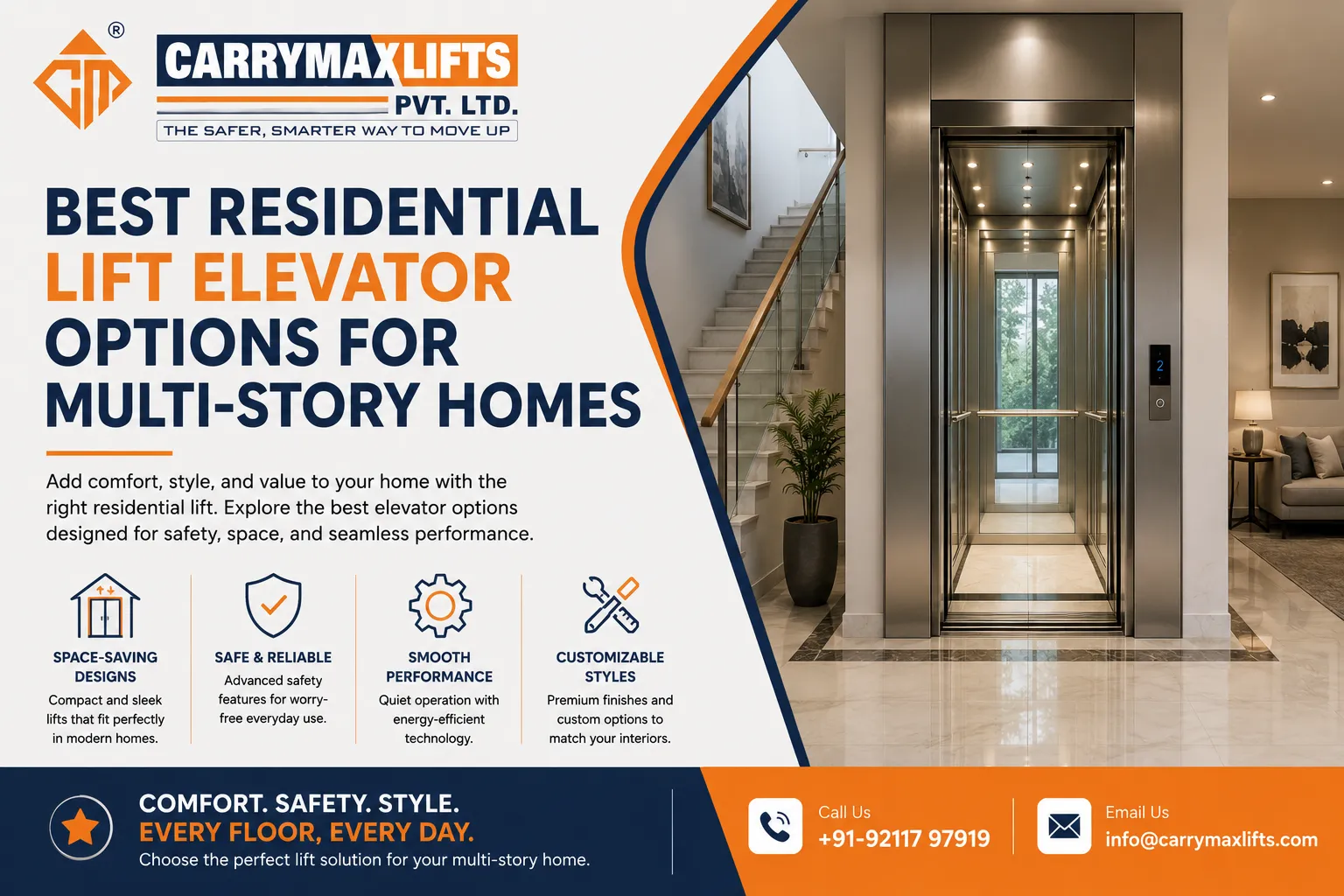
If you own a multi-story home and climbing stairs has started to feel more like a chore than a habit, you are probably already searching for the best residential lift elevator for your property. The good news is that home lifts have become far more accessible in India over the last few years, with options that fit almost any budget, space, and design preference. This guide walks through the real options available, clears up common misconceptions, and helps you figure out which type actually suits your home.
Quick Answer
For most Indian homes, the best residential lift elevator depends on floor count and available space. Hydraulic lifts work well for compact homes up to three or four floors, traction lifts suit taller homes needing smoother rides, and MRL (Machine Room Less) systems are ideal when space is limited. There is no single best option for everyone. The right choice depends entirely on your building's layout and your family's daily needs.
Why Multi-Story Homes Are Choosing Residential Lifts
A decade ago, home lifts were seen as a luxury reserved for large bungalows. That has changed. With more families building three and four-storey homes in cities like Faridabad, Gurugram, and Noida, elevator installation has become a practical necessity rather than an indulgence, especially for households with elderly parents, young children, or anyone with mobility concerns.
There is also a shift in how homeowners think about long-term value. A well-installed lift adds convenience today and resale value later, since multi-storey homes with a working elevator stand out in a competitive property market.
Myth vs Fact: Clearing Up Common Confusion
Myth: Home lifts need a large, dedicated shaft that eats into living space.
Fact: Compact home lift models, especially MRL and hydraulic systems, can fit into spaces as small as a staircase corner or an unused nook, often requiring far less area than most homeowners assume.
Myth: All home lifts are noisy and disrupt the household.
Fact: Modern traction and hydraulic systems from a reputable passenger lift manufacturer operate with minimal noise, especially when properly installed and maintained.
Myth: Home lifts are only for the elderly or people with mobility issues.
Fact: Many families install lifts simply for daily convenience, particularly for carrying groceries, luggage, or moving between floors quickly during busy mornings.
Myth: Once installed, a home lift requires very little upkeep.
Fact: Like any mechanical system, a home lift needs regular lift maintenance services to stay safe and efficient over the years. Skipping this can shorten its lifespan significantly.
Myth: Retrofitting an older home for a lift is nearly impossible.
Fact: With the right structural assessment, most existing homes can be retrofitted, though it does require careful planning around shaft placement and floor cuts.
Types of Residential Lifts for Multi-Story Homes
Choosing the best residential lift elevator starts with understanding what each type actually offers.
Hydraulic Lifts
Hydraulic lifts use a piston mechanism and are a popular choice among home lifts in India for buildings up to four or five floors. They are known for a smooth, steady ride and a relatively simple mechanical structure, which often makes servicing more straightforward.
Best suited for: Independent homes and villas with moderate floor counts and available space for a small machine room.
Traction Lifts
Traction lifts use ropes and a counterweight system, making them a strong option for taller homes or those wanting faster, more energy-efficient movement between floors.
Best suited for: Larger multi-storey homes, especially those with five or more floors, where speed and efficiency matter more.
MRL (Machine Room Less) Lifts
As the name suggests, these lifts eliminate the need for a separate machine room, making them a practical residential elevator solution for homes where space is tight.
Best suited for: Compact urban homes and plots where every square foot counts.
Capsule Lifts
Capsule lifts bring a design-forward, glass-panel aesthetic that many homeowners now prefer, especially in newly constructed homes where the lift is meant to be a visible design feature rather than a hidden utility.
Best suited for: Homes prioritizing interior design alongside functionality.
Hydraulic Lift vs Traction Lift: Which One Fits Your Home
This is one of the most common questions homeowners ask, and the answer depends on two main factors: building height and desired ride quality.
A hydraulic lift vs traction lift comparison generally comes down to this: hydraulic systems are simpler and cost-effective for shorter buildings, while traction systems handle taller homes with better energy efficiency and smoother performance. If your home has more than four floors or if quick, quiet movement is a priority, a traction system is usually the better long-term investment.
Factors to Consider Before Choosing a Home Lift
Before finalizing any option, walk through this checklist:
Available space: Measure the exact area where the lift shaft can be constructed, including any structural walls that might restrict placement.
Number of floors: More floors generally favor traction systems, while shorter homes work well with hydraulic options.
Load capacity needs: Consider whether the lift will occasionally carry more than two or three people, including situations like moving furniture.
Power backup: Check whether your home has reliable backup power, since this affects how the lift performs during outages.
Design preference: Decide whether the lift should blend into the interior or stand out as a design element.
Long-term maintenance: Ask your supplier what a realistic annual maintenance plan looks like before committing.
Comparison Table: Residential Lift Options at a Glance
| Lift Type | Best For | Space Requirement | Ride Quality |
|---|---|---|---|
| Hydraulic | Homes up to 4-5 floors | Moderate, needs small machine room | Smooth, steady |
| Traction | Taller homes, 5+ floors | Moderate to compact | Smooth, energy efficient |
| MRL | Space-constrained homes | Minimal, no machine room | Smooth, compact design |
| Capsule | Design-focused homes | Moderate, often custom shaft | Smooth, visually striking |
Real-Life Example: A Faridabad Family Home
A family in Faridabad with a four-storey home initially assumed a lift would be too complex to retrofit into their existing structure. After a proper site assessment, it turned out an MRL system fit perfectly into an unused corner near their staircase, requiring no separate machine room and minimal structural changes.
The family specifically wanted something that would help their parents move between floors comfortably, and the compact design meant the lift did not disrupt the home's existing layout. This kind of practical, space-conscious planning is exactly what separates a well-executed installation from a rushed one.
Common Mistakes Homeowners Make
Choosing a lift type based on appearance alone without checking floor count compatibility.
Underestimating the shaft space needed and having to redesign midway through construction.
Ignoring lift maintenance services until something breaks down.
Not asking about safety certification, assuming all suppliers meet the same standards.
Selecting the cheapest quote without checking whether installation and civil work are included.
Expert Tips for Choosing the Right Home Lift
Get a site assessment done early, ideally during the home design phase rather than after construction is complete.
Ask your elevator manufacturer for reference installations you can visit, especially homes with a similar floor count.
Prioritize safety features like automatic rescue devices, even if they add a small amount to the base configuration.
Confirm warranty coverage in writing, including what happens if the motor or control panel needs replacement.
Why Choose CarryMax Lifts
CarryMax Lifts has spent years helping homeowners across Delhi NCR find the best residential lift elevator for their specific homes, backed by in-house manufacturing based in Faridabad.
Here is what makes CarryMax stand out among elevator companies in India:
Experience: A strong track record installing home lifts in India across villas, independent homes, and multi-storey residential buildings.
Quality Manufacturing: In-house production means better control over materials, finishing, and long-term durability.
Customization Options: Every home is different, so CarryMax tailors lift configuration to shaft size, floor count, and family needs rather than pushing a fixed template.
Safety Compliance: All installations follow recognized elevator safety standards India requires, including overload protection and rescue systems.
Strong Service in Delhi NCR: With coverage across Delhi, Noida, Greater Noida, Ghaziabad, Gurugram, Panipat, Karnal, Sonipat, Chandigarh, Kurukshetra, Palwal, Jewar, and Bulandshahr, lift maintenance services are always within reach.
Whether you need a compact MRL system for a space-constrained plot or a traction lift for a taller family home, CarryMax Lifts brings the right residential elevator solutions to your project from the very first consultation.
Conclusion
Finding the best residential lift elevator for a multi-story home comes down to understanding your building's specific needs rather than following a generic recommendation. Consider your floor count, available space, and long-term maintenance expectations before choosing between hydraulic, traction, MRL, or capsule systems.
CarryMax Lifts brings years of manufacturing experience, safety-compliant installations, and dependable service across Delhi NCR to every residential project. Reach out to CarryMax Lifts to discuss your home's layout and find the lift option that fits your family best.