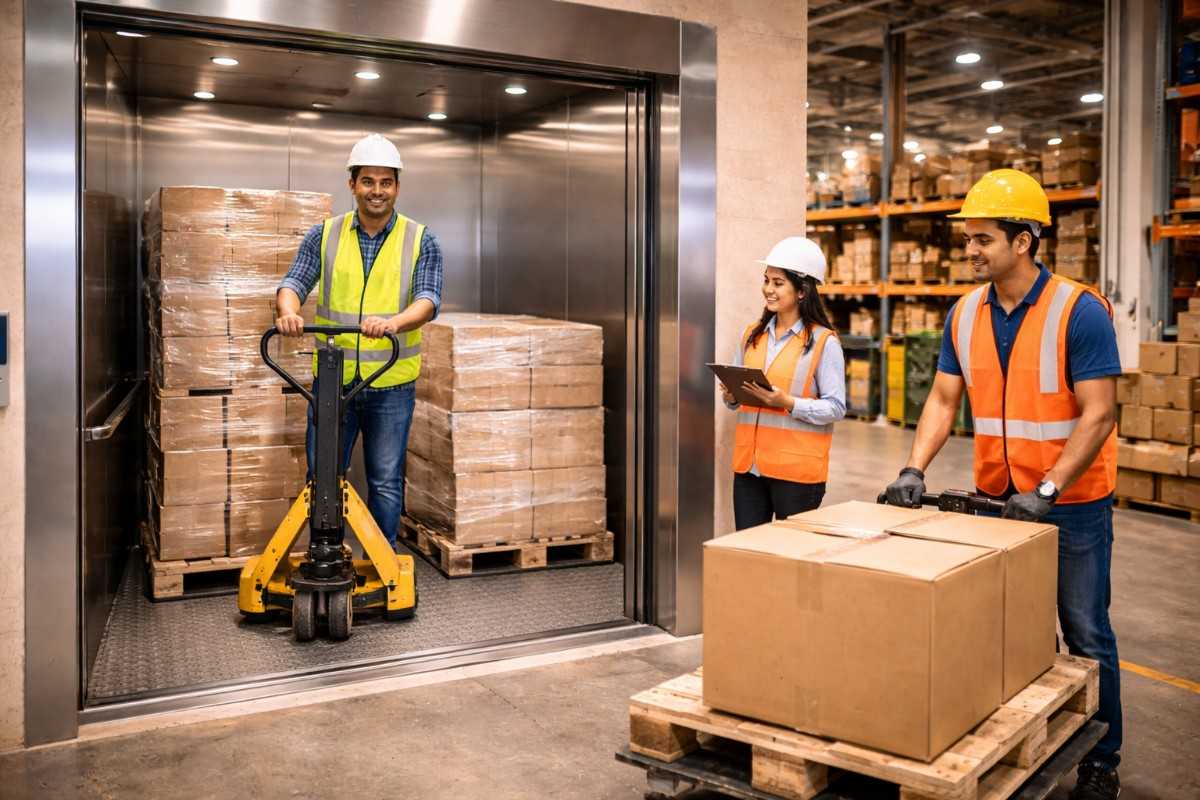
Walk into any modern factory, warehouse, or manufacturing plant in Faridabad, Noida, or Gurgaon today and you will notice something that was rarely seen a decade ago. Industrial freight elevators running continuously between floors, moving everything from raw materials and finished goods to equipment and pallets without a single worker lifting a finger.
Walk into any modern factory, warehouse, or manufacturing plant in Faridabad, Noida, or Gurgaon today and you will notice something that was rarely seen a decade ago. Industrial freight elevators running continuously between floors, moving everything from raw materials and finished goods to equipment and pallets without a single worker lifting a finger.
This is not a coincidence. It is a deliberate shift happening across industries all over Delhi NCR and the rest of India. Facility owners, plant managers, and logistics heads are making the switch to industrial freight elevators at a pace that shows no signs of slowing down.
So what is driving this change? Why are businesses that managed for years with manual handling and basic goods lifts now investing in industrial freight elevators? This blog answers that question with real facts, real examples, and practical insight.
Quick Answer: Why Are Industrial Freight Elevators Growing So Fast
The shift toward industrial freight elevators is being driven by four converging pressures that every facility owner in India is feeling simultaneously.
First, workplace safety regulations are getting stricter. Second, labor costs and dependency are rising. Third, operational efficiency demands are higher than ever. Fourth, modern industrial freight elevator technology has become more accessible, reliable, and practical for facilities of all sizes.
When you add these four forces together, switching to an industrial freight elevator stops being a luxury decision and starts being a logical business necessity.
The Problem That Is Pushing Every Facility Owner Toward Industrial Freight Elevators
Let us be direct about what life looks like in a facility without an industrial freight elevator.
Workers carry heavy loads up staircases or ramps multiple times every shift. Goods get damaged during manual handling. Injuries happen regularly. Productivity slows during shift changes when fatigue sets in. Compliance inspectors flag unsafe manual handling practices. And all of this adds up to a quiet but consistent drain on your facility's output, budget, and safety record.
The worst part is that most facility owners accept this situation as normal. It is not normal. It is an avoidable operational problem that an industrial freight elevator solves completely.
Across manufacturing plants in Faridabad, automotive component factories in Gurgaon, pharmaceutical units in Noida, and warehouses throughout Delhi NCR, the facilities that have made the switch are reporting measurable improvements in every area that matters.
8 Powerful Reasons Why Facilities Are Switching to Industrial Freight Elevators
Reason 1: Workplace Injury Rates Drop Dramatically
Manual material handling between floors is one of the leading causes of workplace injuries in Indian industrial facilities. Back injuries, shoulder strains, knee damage, and fall-related accidents from carrying heavy loads on staircases are documented problems in facilities that rely on manual handling.
When an industrial freight elevator takes over floor-to-floor material movement, the physical burden on workers disappears. Injuries decline. Compensation claims reduce. Absenteeism drops. The human cost of running your facility goes down in a way that directly improves your bottom line.
For facility owners in Delhi NCR who are dealing with rising worker compensation costs and increasing scrutiny from safety inspectors, this single benefit alone justifies the investment in an industrial freight elevator.
Reason 2: Operational Speed Increases Significantly
Think about how long it takes four workers to carry a loaded pallet from the ground floor storage to the second floor production area in your facility. Now think about how long an industrial freight elevator takes to do the same job. The difference is not marginal. It is dramatic.
Industrial freight elevators move loads between floors in minutes. They do not take breaks. They do not slow down at the end of a shift. They handle the same load at 7 AM and at 11 PM with identical speed and efficiency.
In manufacturing plants and warehouses across Faridabad and Noida where production cycles depend on continuous material flow, this speed improvement translates directly into higher output without increasing headcount.
Reason 3: Goods Arrive Undamaged Every Time
Every industry that handles goods between floors deals with a quiet but persistent problem. Damage during manual handling. Dropped boxes. Scraped surfaces. Crushed packaging. Spilled liquids. Broken components.
Each damaged item is a financial loss. For facilities handling electronics, pharmaceutical products, precision-engineered parts, packaged goods, or premium retail inventory, this damage adds up to significant monthly losses that most managers never formally calculate.
An industrial freight elevator moves goods on a stable, enclosed platform with no tilting, no human error, and no fatigue-related mistakes. Goods arrive at the destination floor in exactly the condition they left the origin floor. The damage problem simply disappears.
Reason 4: Labor Costs and Dependency Reduce Over Time
India is experiencing a steady rise in industrial labor costs. Skilled workers expect higher wages. Attrition rates in manual handling roles are high because the work is physically demanding. Training new workers for material handling tasks takes time and resources.
An industrial freight elevator reduces your dependency on manual labor for floor-to-floor material movement. Workers who were previously assigned to carrying loads between floors can be redeployed to skilled production tasks that actually grow your business. Your facility becomes less vulnerable to labor shortages and wage pressures over time.
Across factories in Gurgaon and Delhi that have installed industrial freight elevators, facility managers consistently report that the labor redeployment benefit alone makes a significant difference to their monthly operational costs.
Reason 5: Safety Compliance Becomes Much Easier
Industrial safety regulations in India are evolving rapidly. The Factories Act, Bureau of Indian Standards guidelines, and increasingly rigorous third-party safety audits are putting pressure on facility owners to eliminate unsafe manual handling practices.
A facility that relies on workers carrying heavy loads up and down staircases repeatedly is vulnerable during any compliance inspection. An industrial freight elevator removes this vulnerability completely. It demonstrates a proactive commitment to workplace safety that compliance inspectors, clients, and insurance auditors respond positively to.
For manufacturing units in Faridabad and Noida that supply to large corporations or export to international markets, safety compliance is not just a regulatory requirement. It is a commercial necessity. Industrial freight elevators help you meet that requirement confidently.
Reason 6: The Technology Has Become More Reliable and Accessible
One reason facility owners were slower to adopt industrial freight elevators in the past was concerns about reliability, complexity, and maintenance requirements. Modern industrial freight elevator technology has addressed all of these concerns directly.
Today's industrial freight elevators from quality manufacturers feature advanced electronic control systems, robust hydraulic or traction mechanisms, and components engineered specifically for continuous heavy-duty industrial use. They are designed to operate reliably across two and three shift operations without significant downtime.
Maintenance requirements have also simplified considerably. Structured Annual Maintenance Contracts from manufacturers with local service teams in Delhi NCR mean facilities get regular preventive maintenance and fast breakdown response without building internal elevator maintenance capability.
Reason 7: Space Efficiency Improves Across the Facility
Facilities that rely on ramps, inclined conveyors, or large manual handling zones for floor-to-floor material movement give up significant floor space to these solutions. That space could be used for additional production equipment, storage racks, or expanded workstations.
An industrial freight elevator operates within a compact vertical shaft. It takes a fraction of the horizontal floor space that a ramp or conveyor system requires. For manufacturing plants and warehouses in Delhi NCR where every square meter of floor space represents operational capacity, this space efficiency is a genuine and measurable benefit.
Reason 8: Property and Facility Value Increases
A well-equipped industrial facility commands higher value whether you are selling it, leasing it, or attracting major clients who conduct facility inspections before placing orders.
An industrial freight elevator is visible evidence of serious infrastructure investment. It tells clients, partners, and investors that your facility operates to a professional standard. For facility owners in Faridabad, Gurgaon, and Noida who are growing their client base or considering future expansion, this credibility enhancement is a long-term return on their elevator investment.
Industries Making the Switch Fastest
The shift to industrial freight elevators is happening at different speeds across different sectors. Here are the industries leading this transition across Delhi NCR.
Pharmaceutical Manufacturing: Strict material handling protocols and hygiene requirements make industrial freight elevators essential for moving sensitive materials between floors without contamination risk.
Automotive Component Factories: Heavy parts, assemblies, and raw materials need reliable floor-to-floor movement in high-volume production environments where manual handling is impractical and unsafe.
Cold Storage and Food Processing: Temperature-sensitive goods need to move between floors quickly and without delay. Industrial freight elevators maintain speed and consistency that manual handling cannot match in these environments.
E-Commerce Warehouses: The explosive growth of e-commerce across India has created large multi-floor warehousing operations in Noida and Delhi NCR that depend on industrial freight elevators for continuous inventory movement.
Textile and Garment Manufacturing: Multi-floor production facilities handling fabric rolls, finished garments, and packaging materials benefit enormously from the continuous material flow that industrial freight elevators enable.
Industrial Freight Elevator vs Traditional Goods Handling: The Honest Comparison
Factor | Industrial Freight Elevator | Manual or Basic Handling Load Capacity | Up to several tonnes | Limited by human capacity Daily Consistency | Identical across all shifts | Degrades with fatigue Injury Risk | Minimal | High and documented Goods Damage | Virtually eliminated | Regular and ongoing Compliance Risk | Low with certified systems | High and increasing Labor Requirement | Minimal | Multiple workers per shift Long Term Cost | Lower over time | Rising with wage inflation Facility Credibility | High with clients and auditors | Neutral to negative
What to Look for When Choosing an Industrial Freight Elevator
Not every industrial freight elevator is the right fit for every facility. Here is what experienced facility managers evaluate before making a decision.
Load capacity that exceeds your heaviest regular requirement with room to grow. Always specify above your current maximum load, not exactly at it.
Platform dimensions that accommodate your largest items including pallets, machinery components, or loaded trolleys. Measure before specifying.
Duty cycle rating that matches your operational intensity. A facility running three shifts needs a system rated for continuous heavy-duty use, not occasional operation.
Safety certifications and compliance with Bureau of Indian Standards norms. Non-negotiable for facilities undergoing regular safety audits.
Local service support with committed response times. An industrial freight elevator that stays broken for days in a three-shift facility is a serious operational crisis. Choose a manufacturer with a strong service presence in your city.
Why Choose CarryMax Lifts for Your Industrial Freight Elevator
CarryMax Lifts is a leading elevator manufacturer based in Faridabad with deep experience delivering industrial freight elevator solutions to manufacturing plants, warehouses, pharmaceutical units, cold storage facilities, and logistics hubs across Delhi, Noida, Gurgaon, and the wider Delhi NCR region.
What makes CarryMax the right partner for industrial facilities is their combination of engineering quality, practical understanding of industrial environments, and reliable local support.
Every industrial freight elevator project begins with a thorough site assessment. CarryMax evaluates your facility layout, floor heights, load requirements, shaft availability, and operational intensity before recommending a solution. You receive a system designed specifically for your facility, not a standard catalogue product forced into your building.
CarryMax industrial freight elevators are built to Bureau of Indian Standards safety norms using quality-tested components engineered for continuous heavy-duty use. Customization options cover platform size, door configuration, control systems, and safety feature specifications.
Their after-sales service team operates across Delhi NCR with structured Annual Maintenance Contracts and committed response times. When your elevator needs attention, CarryMax responds quickly so your facility keeps running.
For facility owners and plant managers across Faridabad, Delhi, Noida, and Gurgaon who are ready to make the switch to an industrial freight elevator, CarryMax Lifts is the experienced and locally supported partner that delivers results.
Conclusion
The shift toward industrial freight elevators is not a trend driven by technology for its own sake. It is a practical response to real operational challenges that every industrial facility in India is facing. Rising safety compliance pressure, increasing labor costs, persistent goods damage, and the demand for higher operational efficiency are all pushing facility owners toward a solution that delivers on every front.
Industrial freight elevators eliminate workplace injuries, speed up material flow, protect goods, reduce labor dependency, and help facilities meet the compliance standards that modern industrial operations demand.
Across Faridabad, Delhi, Noida, and Gurgaon, the facilities that have already made this switch are operating faster, safer, and more efficiently than those still relying on manual handling. The question for every facility owner is no longer whether to make the switch but how soon.
CarryMax Lifts is ready to help you make that transition smoothly, reliably, and with the full support of an experienced local team that understands industrial environments across Delhi NCR.
Contact CarryMax Lifts today for a free facility assessment and find out which industrial freight elevator solution is the right fit for your operation.